Finding the Direction That Fits You: A Self-Discovery Workbook for Overthinkers and Multi-Passionate Souls
When interests pull you in multiple directions, the hardest part isn’t motivation—it’s choosing what to commit to without replaying every “what if.” A workbook-style approach turns that vague restlessness into clear next steps by mapping your values, strengths, energy patterns, and real-life constraints into a direction that feels sustainable (not just exciting for a week).
Why direction feels so hard when you’re multi-passionate
Having many genuine interests can look like a gift—until it turns into gridlock. Too many good options create analysis paralysis: more choices, more imagined futures, and more fear of choosing “wrong.” Overthinking often shows up as endless research, comparison, and planning without the decisions that actually create momentum.
Another hidden trap is the belief that liking many things means you must pick only one identity. Multi-passionate people often thrive by combining strengths across contexts, not by shrinking themselves into a single label. In practice, clarity usually comes from structured reflection plus small experiments—not from waiting for a perfect calling to appear. If stress is adding fuel to the mental spin cycle, it may help to understand how it affects focus and the body (American Psychological Association: Stress effects on the body).
What “a direction that fits” actually means
A fitting direction isn’t a magical answer; it’s an overlap. Think of fit as the intersection of:
- Values (what matters most)
- Strengths (what comes naturally and gets results)
- Reality (time, money, responsibilities, health, location)
Fit can be a theme instead of a single job title. For example, “teaching + systems + creativity” could show up in instructional design, operations training, content strategy, or coaching. The goal is a decision you can live with for the next season (3–12 months), with room to iterate as you learn. Signs you’re landing on fit include calmer decision-making, more consistent follow-through, and an internal sense of permission to move forward.
A practical self-discovery framework you can complete in a weekend (then refine)
This framework is designed to create traction fast, then improve with real-world evidence.
Step 1 — Values filter
Identify 5–7 non-negotiables (autonomy, stability, service, creativity, learning, impact, etc.). Use these as a filter: if a path violates two or more non-negotiables, it’s a “no” for this season.
Step 2 — Strengths snapshot
List the skills people rely on you for and the tasks that feel absorbing rather than draining. If you need ideas for role requirements and skill profiles, browse O*NET OnLine to compare what different careers actually demand.
Step 3 — Energy audit
Notice what energizes you, what depletes you, and what conditions change the outcome (people, pace, environment, autonomy, novelty, structure). Energy patterns often reveal your best “mode of work” faster than personality labels.
Step 4 — Constraint check
Write down your current constraints: time, finances, location, health, caregiving, and emotional bandwidth. Then design within reality. Constraints don’t kill dreams—they shape your next step so you can actually execute it.
Step 5 — Direction statement
Step 6 — Next 3 moves
Workbook-style prompts that cut through overthinking
If you catch yourself spiraling into “research mode,” try a pattern interrupt: set a 20-minute timer, make one decision, and write the next calendar action. Practical guidance on breaking repetitive thought loops can also help (Harvard Business Review: How to stop overthinking).
How to move forward without forcing yourself into one box
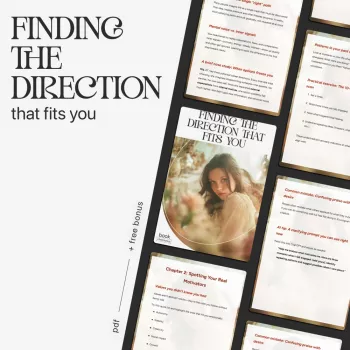
What’s inside “Finding the Direction That Fits You” (digital guide + workbook)
Finding the Direction That Fits You (digital guide + workbook) is built for overthinkers who want clear steps rather than endless open-ended journaling. It walks you through a structured self-discovery flow that connects strengths, values, and interests to real career and life direction decisions—then gives you space to compare options and turn insights into a realistic plan for the next season. Because it’s digital, it’s easy to revisit whenever priorities shift or a new interest emerges.
From confusion to clarity: how the workbook supports decisions
| Common sticking point |
What it feels like |
Workbook outcome to aim for |
| Too many options |
Every choice seems equally possible |
A short list of 2–3 directions that match values and constraints |
| Fear of choosing wrong |
Pressure to find the “one perfect path” |
A reversible next step with clear success criteria |
| Over-researching |
Endless reading without action |
One experiment scheduled within the next 7–14 days |
| No clear identity |
Feeling behind peers or “scattered” |
A personal direction statement you can use to guide decisions |
Small add-ons that support follow-through
Making the most of a career-clarity workbook
FAQ
How long does it take to feel clearer about direction?
A focused weekend is often enough to narrow your options and write a usable direction statement. Deeper confidence usually builds over the next 2–8 weeks as you run small experiments and collect real evidence.
Can a multi-passionate person choose a direction without giving up other interests?
Yes—choose a theme-based direction and commit to one primary lane for this season while keeping a side lane for exploration. This “portfolio” approach protects momentum without forcing you into a single identity forever.
What if overthinking keeps returning even after making a plan?
Use a decision window (like 30–60 days) with pre-defined success criteria, then review on a set cadence (weekly check-ins, monthly revisions). Overthinking can still show up, but a repeatable process keeps it from stealing your next action.
Recommended for you











Leave a comment